Breathing Techniques.
Correct breathing while practicing karate is very important. Karate practitioners use two types of breathing that associated with Chinese philosophy Yin and Yang (陰陽) or In-yō in the Japanese translation.
Yin and Yang (also yīnyáng – “dark—bright”) describe how seemingly opposite or contrary forces may actually be complementary, interconnected, and interdependent in the natural world, and how they may give rise to each other as they interrelate to one another. According to this concept there are two different breathing techniques Ibuki (Yō) and Nogare (In). The combination of these breathing techniques promotes rejuvenation of energy and ensures the body is exercised internally and externally. The goal is to consciously control breathing to unite the mind and body, activate the internal organs and to reach a state of total awareness..
Yin-Yang 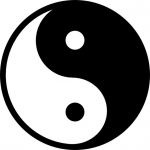
 In-Yō
In-Yō
Ibuki Breathing
Ibuki - translates to “breath” in English, but the combination of the characters to form Ibuki 息吹 means “inner strength”. It is the hard style of breathing, a noisy breathing technique, with the aim of absorbing any opposing force; it is made with a long exhalation and ends with a short exhalation and voice. This type of breathing is employed as a training method and is a strong hissing sound which aids in dynamic tension training.
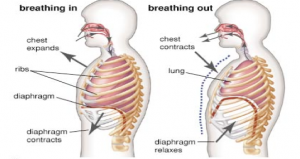 This technique is the channel through which the Hara (Tanden – pronounced dan-ten in Chinese) connects the spirit to the body, through Ki (internal energy). This technique serves to contract the muscles of the body in a single moment and can absorb a blow without suffering much harm, or at least a small part. This contraction, which takes place through the Yō ibuki breathing, contraction is called kime.
The Ibuki type of breathing is the measured but powerful controlled pressure of the abdomen. Heavy abdominal breathing, concentrating in collapsing your diaphragm (and thus your lungs) down instead of inflating them outwards (the breathing movement should be seen in your lower abdomen, not in your ribcage), then breath out by slowly contracting (with or without tension) the abdominal wall (like a stomach vacuum but without holding your breath), which will then push the diaphragm and lungs back up, compressing them and pushing the air out again.
This contraction of the abdominal muscles also pulls the ribcage and hips a bit together, and aids in the development of correct posture for sanchin dachi (gluteal and abdominal muscles contracted, without excessive pelvic tilt caused by using only the glutes and hip flexors).
Alternatively, use Ibuki when blocking a strike or delivering a strike, exhale with force and kiai – or shout. Observe weightlifting training or competition or other martial arts training and you will see that they also use this form of breathing. Weightlifters shout as they exhale, pushing heavy weights. Many athletes, including baseball and football players, even tennis players grunt, groan, or shout during practice or competition. They have been trained to realize that forceful exhaling makes their effort more effective and their body stronger.
Training in Ibuki can be done anywhere and anytime. Start by standing with your feet shoulder width apart and the arms at the sides. Take a deep breath in through the nose. Raise the arms up and across the chest to the shoulders, keeping the hands open. Cross the arms, clench the fists, and tense the entire body. Pay particular attention to tightening the abdominal muscles. With the hands clenched into fists bring the arms slowly down to the sides. Exhale with force through the mouth while keeping tension in the abdominal muscles. Force all the air out and tense even more on the abdominal muscles. Repeat any number of times.
Ibuki breathing can be used after strenuous exercise or to restore breathing after receiving a strike to the abdomen or diaphragm. One note of caution though. At times athletes have felt light-headed and fainted using this self-defense breathing method. Consult your physician before starting any physical, martial arts or self-defense training.
Nogare Breathing
Nogare or “Slow/Soft Breathing”, is the soft but firm type of breathing which starts from deep within the abdomen. This is like the type of breathing which is practiced in Yoga and Zen meditation and is usually directed towards spiritual and meditative matters when practiced. This is the normal way a baby breathes. If you watch a baby breathing it will naturally breathe from the stomach. It is only when we get older that we “learn” to breathe from our chest, shallower. The goal is to return to the “baby breath”.
Nogare is an exceptional skill for any Karateka to cultivate, especially the novice who will become overwhelmed with the lack of air from not breathing within the movement, which can take years to learn.
Training in Nogare can be done anywhere and anytime. Start by standing with your feet shoulder width apart and the arms at the sides. Take a deep breath in through the nose. Raise the arms up to chest level keeping the hands open. Bring the hands alongside the chest and force air into the abdomen. Exhale slowly keeping the tongue relaxed behind the upper teeth. This quiets the breathing. Repeat any number of times.
Nogare is also referred to as combat breathing. It should be used in self-defense encounters. It is slow and quiet with no discernable movement. It is important to not allow your opponent an opportunity to strike when inhaling. The human body is weakest while inhaling. When blocking a strike or delivering a self-defense technique, exhale with force and kiai (a shout). Forceful exhalation makes the technique more effective and the body stronger.
The exercise of Nogare Breathing:
- Stand straight up with the feet shoulder width apart, and with the arms hanging relaxed at the sides.
- Take a deep breath in through the nose and raise the arms up to chest level keeping the hands open.
- Bring the hands alongside the chest and force air into the abdomen. Set the breath in the lower abdomen for a moment.
- With the tongue relaxed behind the upper teeth, exhale slowly.
- Maintain the tongue behind the upper teeth to help to quiet the breathing.
- This is repeated several times until one’s breath is calm, and one’s heartbeat is pacified.
There are many benefits of these two forms of breathing, but the Nogare is definitely easier to learn and perhaps more beneficial to your training and health long term. The controlled breathing of Nogare slows your heart rate. To experience the benefits of Ibuki, try breathing in slowly and out sharply as you strike a pad. It is easy to see the benefits of sharp outward breaths when striking.